
What Makes Hardwood Flooring "Sustainably Sourced"?
“Sustainably sourced” may appear on a flooring website you explore, often without much data or evidence to back the claim. Sometimes the phrase gets attached to products with no third-party verification at all, which makes it hard to tell a genuinely responsible floor from one that’s simply using the right words.
The good news is that once you know what you’re looking for, the claim of “sustainably sourced” is easy to check. That claim rests on a handful of specific, verifiable things: how the forest was managed, whether the wood was legally harvested, how efficiently the material is used, and how transparent the manufacturer is about all of it. This guide below walks through each one, so you can evaluate any hardwood floor, ours included, on the actual evidence rather than the marketing copy.
Quick Answer
Genuinely sustainably sourced hardwood flooring typically means some combination of:
- Independent forest management certification, most commonly FSC (Forest Stewardship Council) or PEFC (Programme for the Endorsement of Forest Certification), verifying the forest itself is responsibly managed
- Chain of custody certification, a separate credential that tracks certified material from the forest through manufacturing to the finished floor
- Documented legal sourcing, meeting requirements like the U.S. Lacey Act or the EU Deforestation Regulation (EUDR)
- Material efficiency, through engineered construction that yields more flooring per log, or reclaimed wood that requires no new harvest at all
- Manufacturing transparency, shown through Environmental Product Declarations (EPDs) and low-emission certifications like GREENGUARD Gold or CARB2
A floor doesn’t need every item on this list to be a responsible choice, but the more of them it can document, the more confidence you can have in the claim.
Why “Sustainably Sourced” Gets Used So Loosely
Forest certification, chain of custody, legality compliance, and low-emission manufacturing are four distinct things, verified in four different ways, yet marketing copy routinely collapses them into a single feel-good phrase. That’s not always dishonest; it’s often just imprecise. But it means the burden falls on the buyer to ask which specific claim is actually being made.

A useful rule when evaluating any sustainability claim: certifications like FSC and PEFC prove chain-of-custody participation for a specific product and legal entity, not blanket sustainability. A valid certificate only covers the exact company, site, and product line listed in its scope, so a parent brand’s certification doesn’t automatically extend to every product it sells, and a general “committed to sustainability” statement on a homepage isn’t the same as a certificate number you can look up. When a claim matters to your decision, it’s worth asking for the specifics rather than taking the language at face value.
How VANTIA Hardwoods and Interiors Sources Sustainable Woods
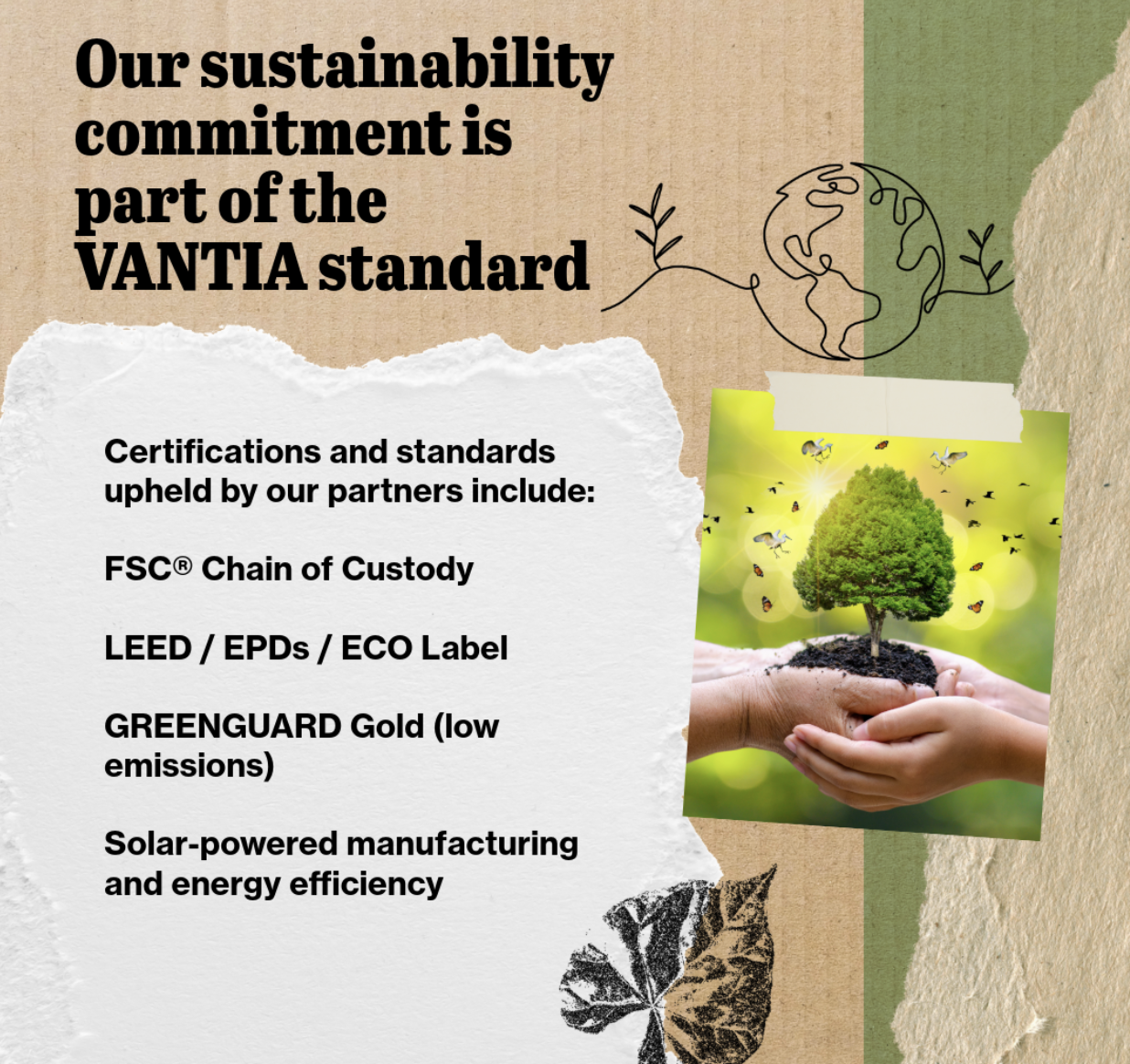
VANTIA works with mill partners across Europe (including Scheucher, Bjelin, and Tierra) chosen specifically because they carry independently verified certifications: FSC and PEFC chain of custody, GREENGUARD Gold, Environmental Product Declarations, the EU Ecolabel, and, for some collections, LEED and Living Building Challenge contributions. Alongside those new-growth lines, VANTIA offers reclaimed wood and authentic barnwood flooring for projects where a zero-new-harvest option, and a more rustic, weathered character, is the right fit.
The full certification breakdown for each of our mill partners, brand by brand, is on our Sustainability at VANTIA page. It’s worth a look once you know which specific credentials matter most for your project.
The Four Pillars of Sustainably Sourced Hardwood

1. Certified Forest Management
This is the foundation. Forest management certification verifies that the forest a tree came from is being managed in a way that maintains long-term forest health, biodiversity, and (in most schemes) the rights of local communities and workers.
The two dominant global systems are:
- FSC (Forest Stewardship Council): operates a single global standard, verified by accredited third-party auditors. FSC issues separate certificates for forest management (FM) and chain of custody (CoC), though the two can be combined for vertically integrated operators.
- PEFC (Programme for the Endorsement of Forest Certification): works as an umbrella system that endorses national forest certification schemes meeting its benchmarks, with chain of custody often bundled into the same certificate as forest management.
Both are legitimate, independently audited systems, and both maintain public databases where a specific certificate can be verified. Neither one is inherently “better,” and many mills carry both.
2. Legal Sourcing and Import Compliance
Certification is voluntary. Legality is not, and it’s worth understanding as its own, separate baseline.
In the United States, the Lacey Act requires importers of wood products to declare species and country of origin and to exercise due care that the material was harvested legally, with real financial and criminal penalties for false declarations. In the European Union, the EU Deforestation Regulation (EUDR) goes further, requiring that timber placed on the EU market be both legally harvested and verifiably free of deforestation that occurred after December 31, 2020.
An FSC or PEFC chain of custody certificate isn’t automatically proof of Lacey Act or EUDR compliance, but it typically supports the due diligence records a responsible importer needs to have on file. Think of legal compliance as the floor every importer must clear, and voluntary certification as the additional layer that proves active, verified forest management above and beyond it.
3. Material Efficiency: Engineered Construction and Reclaimed Wood
Sourcing responsibly isn’t only about where the wood came from; it’s also about how much of the tree actually ends up as usable flooring.
Engineered hardwood is constructed with a real hardwood wear layer bonded over a multi-layer core, rather than a solid plank milled entirely from one piece of timber. That construction means significantly more finished flooring can be produced from the same amount of harvested wood, since the wear layer requires only a thin slice of the log rather than a full-thickness board. Some manufacturers push this further with technology that recovers even more usable material per log, reducing the number of trees needed for a given square footage of flooring.
Reclaimed wood takes a different route to the same goal: it requires no new harvest at all. Boards salvaged from old barns, factories, and other structures are re-milled into flooring, which avoids new cutting entirely and, since the material is often old-growth, frequently delivers a density and character that newer, faster-grown lumber can’t match.
4. Manufacturing Transparency and Indoor Health
The last pillar isn’t strictly about the forest; it’s about what happens after the wood leaves it, and it’s worth understanding as a separate category from forest sourcing, even though the two are usually marketed together.
An Environmental Product Declaration (EPD) is a standardized, third-party verified report of a product’s environmental impact across its lifecycle, based on the ISO 14025 framework. It doesn’t grade a product as “good” or “bad”; it discloses the data so buyers and architects can compare products on the same terms. Certifications like GREENGUARD Gold (low chemical emissions) and CARB2 (California’s formaldehyde emission standard for composite wood products) address indoor air quality specifically, which matters most if the adhesives, finishes, or engineered core involve manufactured wood products. Natural oil finishes and formaldehyde-free adhesives are the manufacturing-side choices that typically earn these certifications.
How to Verify a Sustainability Claim Yourself

You don’t need to take a brand’s word for any of this. A few minutes of checking will tell you whether a claim is backed by something real:
- Ask for the certificate number, then look it up directly in the FSC (info.fsc.org) or PEFC (pefc.org/find-certified) public databases rather than relying on a logo on a brochure.
- Confirm the certificate covers the specific product, not just the parent company. Certificates apply to a defined legal entity, site, and product scope, and don’t automatically extend to every line a company sells.
- Separate marketing language from documentation. “Eco-friendly” and “sustainably sourced” are not certifications; FSC, PEFC, and a listed certificate number are.
- Ask how legality is documented for any imported species, especially anything sourced from regions with a history of illegal logging.
- Request the EPD or emissions certificate if indoor air quality is part of your decision, particularly for engineered products with manufactured cores or factory-applied finishes.
Common Myths About Sustainable Hardwood Flooring
Myth: Solid Hardwood Is Always More Sustainable Than Engineered
- Solid hardwood isn’t automatically the greener choice. Engineered flooring’s thin wear-layer construction typically produces more finished square footage per tree than a full-thickness solid plank, which is a real efficiency advantage, provided the core materials and adhesives are also responsibly sourced and low-emission.
Myth: Reclaimed Wood Is the Only Truly Sustainable Option
- Reclaimed wood is an excellent choice, but it isn’t the only credible one. Certified new-growth forestry, managed on a sustainable-yield basis with active replanting, is designed to supply wood indefinitely without depleting the resource, which is a different but equally legitimate model of sustainability.
Myth: Any “Eco-Friendly” Label Means It’s Certified
- Plenty of flooring is marketed as eco-friendly with no certificate behind the claim at all. The presence of a specific, checkable certification (FSC, PEFC, an EPD, GREENGUARD Gold) is what separates a documented claim from a marketing one.
How to Choose Sustainably Sourced Flooring for Your Project
Step 1: Decide What Matters Most to You
Forest management, carbon impact, indoor air quality, and budget don’t always point to the same product. Knowing your priority up front makes the rest of the decision much faster.
Step 2: Ask for Certification Numbers, Not Just Claims
A specific FSC or PEFC certificate number, or an EPD, gives you something you can verify. A general sustainability statement doesn’t.
Step 3: Factor In Supply Chain Distance
A mill sourcing timber within a few miles of its factory, or a domestic reclaimed-wood supplier, carries a different transportation footprint than material shipped from across the globe. It’s a legitimate factor to weigh alongside certification.
Step 4: View Samples and Ask for Documentation
Once you’ve narrowed your options, ask your supplier to show you the actual certificates or EPDs behind the products you’re considering, not just the marketing page. A supplier who can produce that documentation readily is a good sign in itself.
Frequently Asked Questions
What does "sustainably sourced" actually mean for hardwood flooring?
It generally refers to some combination of certified forest management (like FSC or PEFC), documented legal sourcing, efficient use of harvested material, and transparent, low-emission manufacturing. The strongest claims are backed by a specific, verifiable certificate rather than general marketing language.
Is FSC certification the same as "sustainably sourced"?
FSC certification is one of the strongest, most specific pieces of evidence behind a sustainability claim, but it’s not the only factor. A fully credible claim also considers legal sourcing compliance, material efficiency, and manufacturing transparency.
Is engineered hardwood more sustainable than solid hardwood?
In terms of raw material efficiency, often yes. Engineered flooring’s thin hardwood wear layer over an engineered core typically yields more finished flooring per tree than a solid plank does, though the sustainability of the core material and adhesives matters too.
Is reclaimed wood flooring more sustainable than new wood?
Reclaimed wood avoids new harvesting entirely, which is a genuine advantage, but certified, responsibly managed new-growth forestry is also a legitimate and sustainable sourcing model. Neither one is objectively “more sustainable” in every case; they represent different approaches.
Does sustainably sourced flooring cost more?
It can, though not always. Certification, documentation, and responsible manufacturing sometimes add cost, but reclaimed wood and material-efficient engineered flooring can be comparably priced, or even more affordable, than some conventional solid hardwood options.
How can I verify a flooring brand's sustainability claims?
Ask for the specific certificate number and check it against the public FSC or PEFC database, confirm the certificate covers the exact product you’re buying, and ask for supporting documentation like an EPD if manufacturing transparency matters to your decision.