
Tired of Your Floors Gapping? Lock them into Place.
Shopping for wood flooring eventually leads everyone to the same fork in the road: do you opt for a tongue-and-groove floor (T&G) that requires nails and glue, or one that clicks together with a modern 5G locking system?
That’s really the only comparison that matters here — 5G vs. T&G.
The short version: T&G relies on nails, glue, straps, tapping blocks, and the installer’s skill to hold a tight seam. That seam is exactly where floors tend to fail over time — gapping, movement, water damage. 5G replaces that glue joint with a precision-milled mechanical lock that’s consistent from plank to plank, holds tight through seasonal humidity swings, and still gives you the option to bond it to the subfloor for extra stability when you want it. So if a floor’s weak point has always been the seam, why keep relying on old technology using nails, glue, and a steady hand to hold it together?
What Is Tongue-and-Groove?

Tongue-and-groove is the installation method most people picture when they think of a “traditional” wood floor. Each plank is milled with a protruding “tongue” along one edge and a matching “groove” along the opposite edge. To install it, the tongue of one plank slides into the groove of the next, and the boards are then either nailed down through the tongue and/or bonded to the subfloor (and to each other) with adhesive. It’s a proven, decades-old method — but almost entirely on the installer.
What Is “5G” in Flooring?
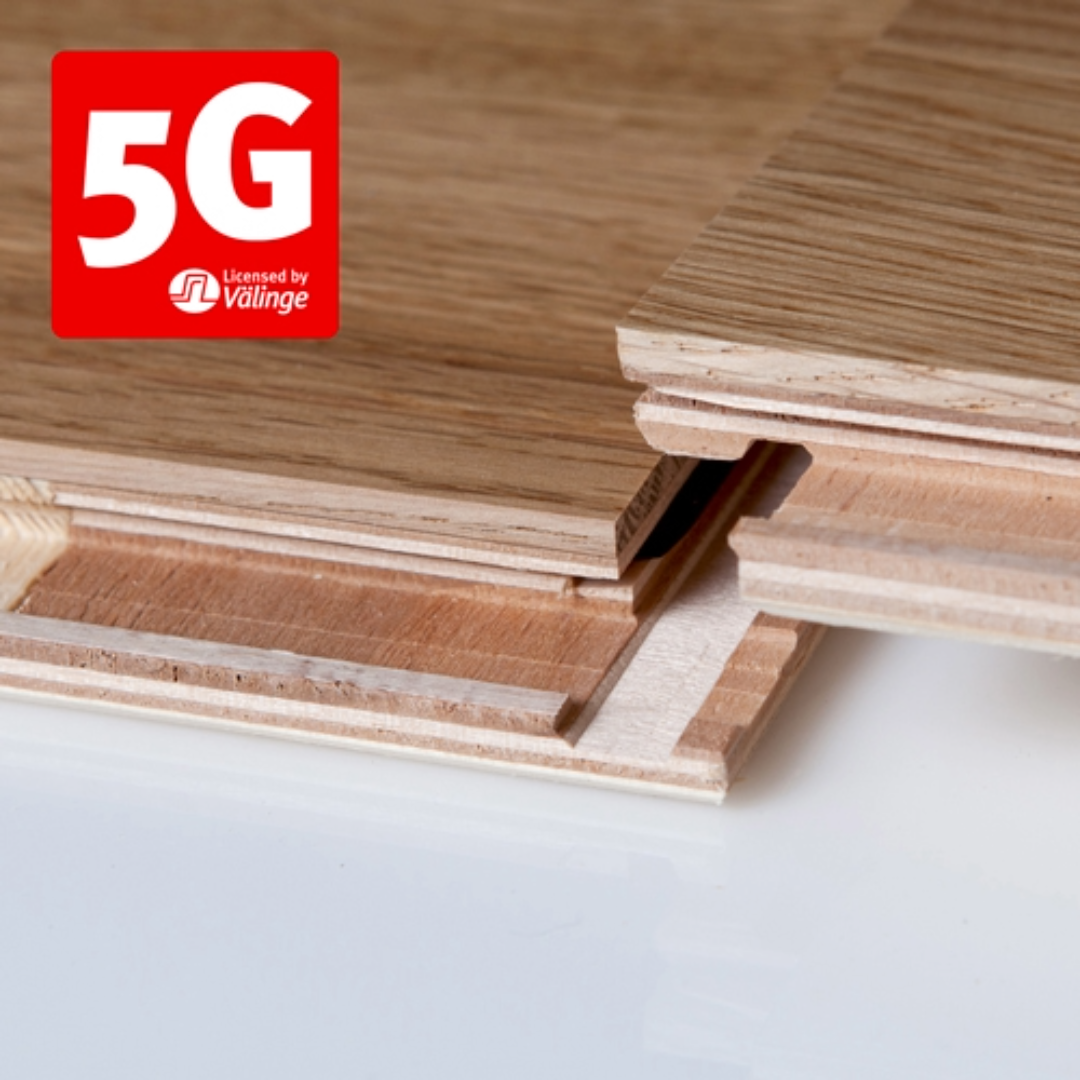
“5G” has nothing to do with wireless networks. In flooring, it refers to the fifth generation of glueless mechanical locking technology — a naming convention pioneered by Välinge Innovation, which has licensed its click systems across the flooring industry for decades. Straight from Välinge’s own technology page: 5G Fold Down is built as a single-action installation method that works across materials, widths, and thicknesses, and is positioned as the fastest, easiest, and most reliable way to install a floor, whether you’re a professional or doing it yourself. The numbers just track generations: 2G was the second-generation profile, 5G is the fifth, and manufacturers across the industry license and apply it to their own products (sometimes pairing it with a different profile on the short edge, as Bjelin does with its watertight 5G Dry joint).
The core mechanic is simple: angle a panel’s long edge in, fold it down, and a flexible insert snaps into a wedge groove as the panel reaches its final position — an audible click, and the plank is locked both vertically and horizontally: no glue, no nails, no tapping block.
Click-Lock (5G) vs. Tongue-and-Groove: The Head-to-Head
| 5G Click-Lock | Traditional Tongue-and-Groove | |
| Install methods | Angle the long edge in, fold down — locks with an audible click. Floats as one connected unit, moving naturally with humidity and temperature. Can be glued as well for a solid feel. | The only option is to fix it to the subfloor, with less tolerance for seasonal movement, and it can be squeaky. Cannot be floated. |
| Skill level required | Beginner-friendly, one person, one motion | Best left to experienced installers |
| Dimensional stability | Locks tight with no seasonal gapping; lays flat and stays flat, even on wide planks | More prone to seasonal movement and gapping at the seams |
| Short-end joints | Self-locking short-end blocks close the gap that usually opens up seasonally | Short ends are typically the first place gaps appear over time |
| Mess and cleanup | No adhesive spread, spills, or squeeze-out if using a floated installation. | Glue application means cleanup, odor, and disposal of excess adhesive |
| Water resistance | 5G Dry is specifically engineered to seal joints against spills and standing water | Glue joints aren’t designed to resist water — moisture at seams is a common failure point |
| Radiant/underfloor heating | Well-suited to radiant heat systems – depending on species | Performs adequately but has less tolerance for the expansion/contraction cycles – depending on species |
| Speed of installation | Up to 2x faster than traditional methods | Requires straps, tapping block nails, and adhesive, which can slow the overall project timeline |
Worth noting: the appeal here isn’t really about DIY ease, though that’s a nice side benefit. The bigger story is dimensional stability — especially on wide-plank floors, where a tight, self-locking joint is what keeps boards lying flat and staying flat over years of seasonal humidity swings.
Now that you know what each platform actually is, it’s worth seeing how the technology plays out in real products. Both Scheucher’s WOODflor NOVOLOC® 5G and Bjelin’s Woodura5G Dry use the same underlying locking technology described above, developed and licensed by Välinge Innovation.
5G in the Real World: Two Products, One Technology
Scheucher’s NOVOLOC® 5G uses the fold-down 5G technology in their 3-layer engineered wood parquet, made in Austria, with a ~3.6 mm solid-wood wear layer that can be sanded and refinished multiple times, underfloor heating compatibility, a 30-year residential warranty, and the RELOC transition element for changing plank direction between rooms without visible gaps. Due to their kiln-dried process, this flooring requires little to no acclimation.
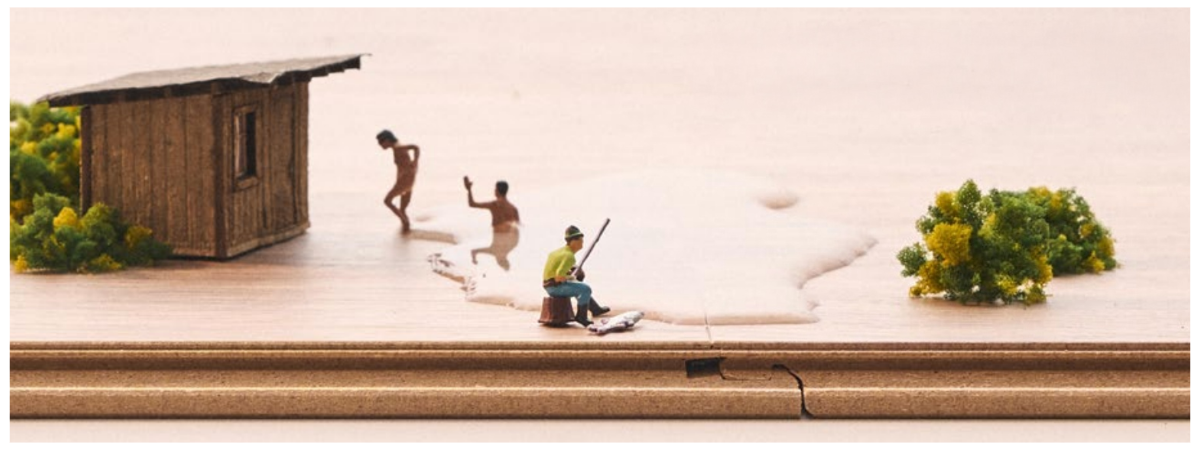
Bjelin’s 5G Dry takes the same fold-down 5G mechanism and adds a watertight joint. Woodura flooring handles spills and standing water for up to 72 hours without liquid reaching the subfloor, and holds up to 48 hours under the NALFA leak-through testing standard. It also supports transition-free spans up to 82 feet and skips the acclimation period most wood floors require.
Both product lines can also be installed as a full trowel glue-down, still clicking together edge-to-edge, but bonded to the subfloor with adhesive for a fully fixed installation. That’s a different thing from switching to a separate tongue-and-groove profile: it’s the 5G joint plus glue, not the 5G joint replaced by glue.
Why 5G Wins — Not Because of Branding, But Engineering
NOVOLOC® 5G and 5G Dry aren’t competing marketing claims. They’re two applications of the same Välinge-engineered click-lock system, and both land on the same conclusion: a well-engineered 5G click-lock outperforms tongue-and-groove for most flooring projects.
- A tighter, more consistent joint. The locking geometry is milled into the plank itself, rather than depending on installer technique, which is also what eliminates seasonal gapping at both the long and short edges.
- Glue-down is still an option — without giving up the click joint. Both NOVOLOC® 5G and Bjelin’s Woodura can be fully bonded to the subfloor with adhesive when a project calls for it, and the planks still click-lock together the same way. You get the option of a permanent, fully bonded floor without trading away the tight, self-locking 5G joint that a separate T&G profile can’t match.
- The joint holds up where floors actually fail. Whether that’s Scheucher’s proven long-term stability and 30-year warranty, or Bjelin’s engineering against water intrusion and seasonal gapping, the improvement is concentrated exactly where T&G floors are weakest: the seam.
- No squeaking sounds. The tight, super-strong joints make them lock together without the play or shifting that lets boards rub against each other and squeak underfoot — a common complaint on older, loosened T&G floors as the glue bond wears, nails loosen, or seasonal movement opens up the seam.
Glue-Down Isn’t a Fallback — It’s Reinforcement
Gluing down is still very much part of the picture, and that’s a good thing. Adding adhesive under a 5G floor doesn’t replace the click joint or compete with it — it reinforces it. The planks still click-lock together edge-to-edge exactly as designed, and the adhesive bond to the subfloor adds an extra layer of dimensional stability on top of that, which matters most on wide-plank floors, large open rooms, or projects with heavier subfloor movement. You’re not choosing between “the modern click system” and “the traditional bonded floor” — glue-down and 5G work together, and the combination is more stable than either the click joint or a straight T&G glue-down on its own. By choosing a full trowel glue installation, you get a physical (5G) and chemical (adhesive) bond. Not only is this superior to the TnG nail with glue, but the floor feels solid, has no hollow spots, and no squeaks.
The Bottom Line
One technology, two trusted applications, one clear conclusion: 5G click-lock — Välinge’s fifth-generation locking system, whether you meet it through Scheucher’s NOVOLOC® 5G or Bjelin’s watertight 5G Dry — installs faster, seals tighter, and performs more predictably over time than traditional tongue-and-groove nail and glue-down flooring. The real question isn’t “which click system” — it’s whether your project calls for Scheucher’s renovation-friendly solid wear layer engineered flooring, or Bjelin’s leak-proof joint and hardened Woodura surface.
We offer free samples for both Scheucher and Bjelin, so the easiest way to settle it is to click a joint together yourself.